New GST Rate on Construction Materials 2025 – Cement, Sand, Steel, Bricks & More
Latest GST rate on construction materials in 2025 including cement, sand, steel, and bricks. Check updated taxes and cost impact for builders and buyers.
Published on December 9, 2025
Table of Contents
GST on Construction Materials 2025 – Cement, Sand, Steel, Bricks & More
What is GST & Recent Changes in GST?
Chart: GST Rate on construction Materials 2025
What is the GST Rate on cement in 2025?
What is the GST Rate on Sand in 2025?
GST on Bricks 2025: Clay, Fly Ash & Cement Bricks
What is GST Rate on Iron, Steel in 2025?
GST Rate on Building Stones, Gravels, & Marble & Granite in 2025
GST on copper wire and other electrical fittings
GST on Paint, wallpapers and varnish
GST Rate on bathroom fittings and interior accessories
Old GST Vs New GST on Construction Material
What will be the Impact of GST 2.0 on Construction Cost?
Input Tax Credit (ITC) for Builders
GST on Construction Materials 2025 – Cement, Sand, Steel, Bricks & More
Construction is the backbone of any growing country; it contributes to employment and infrastructure development.
If you are a homebuyer, contractor, builder, or real estate developers, the cost of construction materials directly impacts your budget. In 2025, the GST Council of India announced a major change in the GST slabs for key construction materials such as cement, sand, steel, bricks, stone, etc.
In this blog, we will see the new GST on construction materials in 2025, like cement, sand, steel, bricks, etc., and their impact, and answer common questions.
What is GST & Recent Changes in GST?
GST is known as Goods and Services Tax, it is applied to goods and services across the country, and depends on the type of goods or services.
Earlier, there was a heavy GST on some goods; for example, the GST on cement was 28%. But recently, the GST council has decided to reduce the tax to reduce the burden on builders, contractors, homebuyers, and boost affordable housing. The changes in GST will apply from 22 September 2025.
Chart: GST Rate on construction Materials 2025
The GST council made a significant decision on September 22, 2025, that will directly impact the real estate and construction costs. This decision is taken to ease cost pressure on the housing sector and encourage new construction.
The GST council has divided the new tax slab into two categories: 5% and 18%. Here is a table below that shows the current GST rate on the different construction materials.
Construction Material | GST Rate |
Pebble, gravel and crushed stone | 5% |
Natural Sand | 5% |
Building stones | 5% |
Iron and steel products | 18% |
Tiles (roofing) | 5-18% |
Bamboo Flooring | 5% |
Insulated wires and cables | 18% |
Ceramic goods and refractory bricks | 18% |
Locks | 18% |
Sanitary Wares | 18% |
Pipe Fitting | 18% |
Wallpapers | 18% |
Fly-ash bricks | 5% |
Coal | 18% |
Sand lime bricks | 5% |
Marble and granite | 5% |
Note: The GST rate as shown above is subject to the GST Council; please consult with official sources.
What is the GST Rate on cement in 2025?
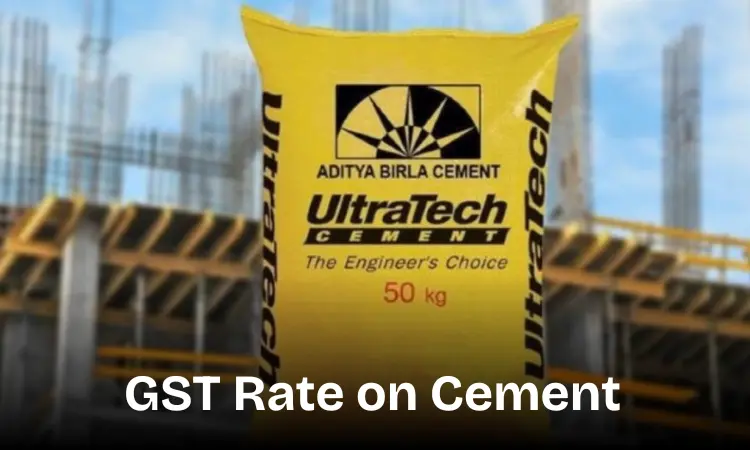
In recent years, the demand and prices of Cement have rapidly increased due to growing infrastructure and logistics costs.
But it increases the construction cost for developers, homeowners, and contractors. However, the new GST Slab on Cement has decreased from 28% to 18%, which offers some relief, and ultimately, it will reduce the construction cost.
Here is a list of the new GST rate on Cement effective from 22 September 2025:
Construction Material | Cement GST Rate |
Aluminous Cement | 18% |
Refractory Cement | 18% |
Super Sulphate Cement | 18% |
Portland Cement | 18% |
Mortars | 18% |
Concrete | 18% |
Cement bonded particle board | 5% |
Slag Cement | 18% |
Example Calculation
If a bag of cement costs Approx. ₹350:
Old GST (28%) = ₹98 tax → Total = ₹448
New GST (18%) = ₹63 tax → Total = ₹413
For 1000 bags, this means savings of ₹35,000.
What is the GST Rate on Sand in 2025?
Sand is another crucial raw material for construction, whether it is river sand or manufactured sand (M-sand). The new GST rate on sand is 5%.
But the sand under the classification of Oil shale/bituminous, asphaltic rocks, natural asphaltites, tar sand, and asphalt has the GST rate of 18%.
Here is the new GST rate on sand in 2025.
Material | GST on Sand |
Natural Sand | 5% |
Oil shale/bituminous, asphaltic rocks, natural asphaltites, tar sand, asphalt | 18% |
GST on Bricks 2025: Clay, Fly Ash & Cement Bricks
Brick is a common construction material that comes in different forms, like clay bricks, fly-ash bricks, sand-lime bricks, and cement blocks.
Here is a quick comparison of the old GST rate and the New GST rate on Sand.
Brick Type | Old GST Rate | New GST Rate |
Normal Clay Bricks | 12% | 5% |
Fly Ash Bricks | 12% | 5% |
Sand-lime Bricks | 12-18% | 5% |
Cement Blocks | 18% | 12% |
GST on Fly Ash Brick: The GST on fly ash brick is 5% now. It is a widely used brick that costs approximately. 20-25% less than the traditional clay brick, and saves energy, and reduces mercury pollution.
GST on Pover Block: All kinds of Pover Block have a GST of 12%. There are different kinds of paver blocks, like Concrete Paver Blocks, Clay Brick Pavers, Natural Stone Pavers, Rubber Pavers, etc., that come under this.
What is GST Rate on Iron, Steel in 2025?
Both Iron and GST are important raw materials for construction. It is used from residential projects to large-scale infrastructure development; its demand is constant.
All kinds of steel and iron have the same GST rate of 18% there is no change in 2025.
GST Rate on Building Stones, Gravels, & Marble & Granite in 2025
The GST on all kinds of building stones is 5% whether it is basalt, sandstone, porphyry, etc. On the other hand, the GST on gravel, crushed rocks, and pebbles is 5%.
Construction Material | GST |
Building Stones | 5% |
Pebbles, Gravels | 5% |
Crushed Stones | 5% |
Earlier, the GST on marble and travertine blocks was 12% and now it has been reduced to only 5%
The tax has been reduced to various materials like gravel, broken or crushed stones, pebbles, ballast, road metalling, macadam of slag, dross, or identical industrial waste, etc.
The GST on materials used for cement manufacturing, like limestone and limestone flux, is also reduced.
GST Rate on Murum Soil 2025
Murum soil is an important construction material that is widely used in construction for backfilling and leveling work. It is a mixture of clay, sand, gravel, and silt.
Murum soil has a red or brownish colour due to the presence of oxide. The GST on Murum soil is 18%.
GST on tiles and wood in 2025
Both tiles and wood are important interior finishing materials. The GST on all kinds of tiles falls under the 18% tax slab. Different kinds of tile material fall under this GST slab, and they are:
Ceramic tiles, vitrified tiles, and floor tiles
Plastic wall and floor covering
Tiles made up of artificial stone and cement
Flooring blocks, Paving tiles, wall tiles, etc.
Wood is a crucial internal and external finishing material that is widely used in the construction of homes or commercially. As per the new GST tax slab, the GST on bamboo flooring and veneer sheets has been reduced to 5%.
GST on copper wire and other electrical fittings
The GST on copper wire and cables is 18% GST. On the other hand, the GST rate on sound recording instruments, TV audio, video recorders, electrical machinery, and other accessories is also 18% GST.
GST on Paint, wallpapers and varnish
The GST on interior designing products is 18% like resin cement, wallpaper, glazier’s putty, grafting putty, etc. In addition to it, the GST on Paints and varnishes with enamels and lacquers is also 18%.
Earlier, the GST on paint was a 28% rate, but after the new GST tax slab, all kinds of paint are 18%. This new GST is applied to all kinds of paints, such as:
Product | New GST Rate |
Paints & varnishes (aqueous medium; incl. acrylic/vinyl emulsions) | 18% |
Dyes & colouring matter (synthetic organic) | 18% |
Paints & varnishes (based on synthetic polymers/acrylics, non-aqueous) | 18% |
Artists’/students’ colours, signboard painters’ colours | 18% |
Water-based paints
Oil-based paints
Varnishes
Enamels
Primers
Emulsions
Distempers
GST Rate on bathroom fittings and interior accessories
The GST on interior accessories and bathroom fittings is at an 18% rate. Here are different kinds of bathroom fittings and accessories that come under this tax slab:
The GST on pipe fittings and tubes is 18% while the new GST on plastic pipes and hoses is just 5%.
Different bathroom fittings like washbasin, bathtub, ceramic sink, sanitary fixtures, etc. have an 18% rate.
In addition to it, all other parts of steel and iron used for hygienic purposes have an 18% GST rate.
Old GST Vs New GST on Construction Material
Here is the quick comparison between the Old GST rate and the new GST rate on some common construction materials.
Materials | Old GST Rate | New GST Rate |
Cement | 28% | 18% |
Fly Ash Brick | 5% | 5% |
Iron & Steel | 18% | 18% |
Sand (natural & manufactured) | 5% | 5% |
Steel (TMT Bar, Rod) | 18% | 18% |
Paint | 28% | 18% |
Pipe (PVC, CPVC) | 18% | 18% |
Glass Sheet | 18% | 18% |
Tiles (Ceramic, Vitrified) | 18% | 18% |
Wood | 5% | 5% |
Bricks | 12% | 5% |
Electrical wiring & switches | 18% | 18% |
What will be the Impact of GST 2.0 on Construction Cost?
The new GST tax slab will significantly change the way construction costs are calculated in India. For example, Cement is the backbone of any construction, and a reduction in GST from 28% to 18% will definitely reduce the construction cost.
In addition to it, other important materials like bricks, sand, and fly ash have come under 5% tax slab. As per the estimate, this reduction in GST could save 3–5% of the total project cost.
Input Tax Credit (ITC) for Builders
ITC or Input Tax Credit is the amount of GST paid by a registered buyer during the purchase of goods and services; you can use that tax amount to reduce the GST you need to pay later when you sell your own product or service.
If you are a registered builder or buyer under GST, you can claim ITC (Input Tax Credit) on the GST you have paid for the Construction material.
For commercial buildings/property rentals, under certain conditions, ITC may be claimed.
You cannot claim ITC if a property is for sale or personal use; it is a major limitation.
Conclusion
Overall, the new GST rates on construction materials will bring relief to builders, contractors, and homebuyers.
Now, Cement, paints, and tiles are taxed at 18% instead of 28%; on the other hand, bricks, sand, fly ash, and marble have only 5% GST, which will reduce the construction cost.
This not only helps reduce the overall cost of building homes but also encourages more affordable housing projects. The change in GST makes construction more transparent, fair, and cost-efficient.
Frequently Asked Questions
Related Posts