
Explore the Delhi–Dehradun Expressway’s cost, route, and completion details. Learn how this mega project will cut travel time and boost connectivity and growth.
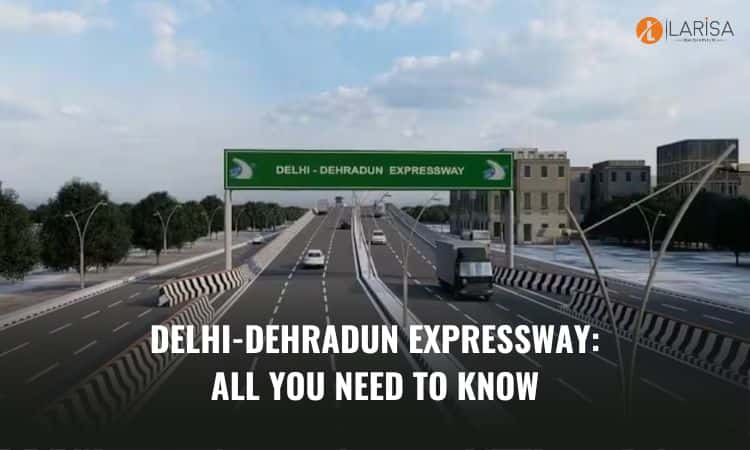
Table of Contents
Delhi Dehradun Expressway: Cost, Route Map, Completion Date, & More
Delhi Dehradun Expressway is a vital greenfield-brownfield expressway connecting the national capital, Delhi, to Uttarakhand capital, Dehradun. This expressway is also known as the Delhi-Saharanpur-Dehradun expressway.
Now, it takes approximately 5-6 hours to reach Dehradun from Delhi, but after the competition of this expressway, it will reduce to 2.5 hours. This will also reduce time travel and traffic congestion, and it will boost the real estate around the expressway.
The project, announced as part of India’s broader infrastructure development plan, involves significant investment and is expected to be completed in December 2024. The expressway is expected to boost economic activities by improving connectivity for businesses and tourism in the region.
It will facilitate more accessible access to the hill stations and pilgrimage sites in Uttarakhand, enhancing tourism. The total length of the Delhi-Dehradun Expressway is 210km.
What is the cost of the Delhi Dehradun Expressway? The cost of the Delhi Dehradun expressway is approx. ₹12000 crore ($1.6 billion). This route will pass through Delhi, Uttar Pradesh, Uttarakhand, and various cities like Baghpat, Shamli, Baraut, and Saharanpur.
Also Read – Simple birthday Decoration Ideas At Home
Delhi Dehradun Expressway Route Map
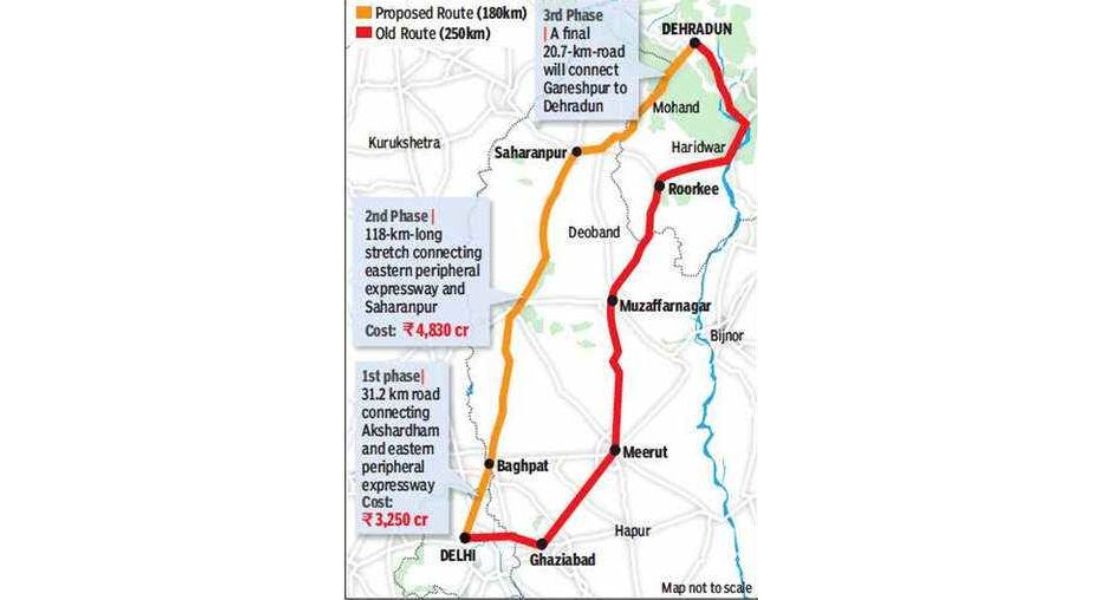
It is a 210km expressway that directly connects Delhi and Dehradun. The Delhi-Dehradun route map connects Delhi, Uttar Pradesh, Uttarakhand, and various cities such as Saharanpur, Shamli, Baraut, Baghpat, etc.
This project will connect Delhi and Dehradun by a total of four routes. Here are the four routes of this expressway
1. Delhi to Eastern Peripheral Expressway
This is the first phase of Delhi Dehradun expressway, which is 32-km long. It will start from Akshardham Temple and go to the Eastern Peripheral Expressway intersection.
2. Eastern Peripheral Expressway to Saharanpur
This is a 6 km-long route that has a total length of 118 km. It starts from the Eastern Peripheral Expressway and goes up to Saharanpur East. This route has seven interchanges.
3. Saharanpur To Rajaji National Park
This is the third route of the Delhi-Dehradun expressway. It starts from Saharanpur east bypass and ends in Ganeshpur on the NH-307. The route is 40km long and also connects Rajaji National Park.
4. Rajaji National Park to Dehradun
This is the final phase of the Delhi Dehradun expressway, which started in August 2022. It is a 20-km route that consists of a 2-km tunnel.
Also Read – Simple Main Door Design Ideas
Delhi Dehradun Expressway Village List
District | Village |
Saharanpur |
|
Baghpat |
|
Muzaffarpur |
|
Shamli |
|
Interconnectivity of Delhi-Dehradun Expressway
This expressway will also offer seamless connectivity to other expressways, decreasing time travel and distance. Dehradun-Delhi Expressway is well-connected to other expressways like:
Saharanpur-Haridwar Expressway
Eastern-Peripheral Expressway (a 135 km long expressway between Delhi and Baghpat)
Ambala-Shamli Expressway (it is a 121.786km long expressway which connects Ambala and Shamli)
Also Read – Easy Rangoli Design Ideas
Dehradun Delhi Expressway Phases
This Expressway is divided into four phases, each focusing on different route segments to ensure systematic and efficient construction. Here is a detailed description of each phase of the project:
Phase 1: Delhi to Eastern Peripheral Expressway (EPE) Junction
Length: The length of the first phase is Approximately 32 kilometres.
Type: Brownfield
Route: The First phase starts from the Akshardham Temple area in Delhi and extends to the Eastern Peripheral Expressway junction.
Key Features
Elevated sections and underpasses to avoid congestion within Delhi.
Integration with existing road networks to facilitate seamless connectivity.
Phase 2: EPE Junction to Saharanpur Bypass
Length: The length of phase 2 is 118 km.
Type: Greenfield
Route: This phase extends from the EPE junction through parts of Uttar Pradesh, reaching the Saharanpur Bypass.
In phase 2, there will be seven interchanges and 60 underpasses.
Key Features
Six-lane access-controlled Expressway, with the potential for expansion to eight lanes.
Incorporation of modern amenities such as service roads, rest areas, and emergency facilities.
Phase 3: Saharanpur Bypass to Ganeshpur
Length: Approximately 40 kilometers.
Type: Brownfield
Route: This phase covers the stretch from the Saharanpur Bypass to the area near Ganeshpur in Uttarakhand.
Key Features
Enhanced safety features, including proper signage, barriers, and surveillance systems.
Wildlife crossings and eco-friendly measures to minimize environmental impact.
Phase 4: Ganeshpur to Dehradun
Length: Approximately 19.508 kilometres.
Type: Brownfield
Route: This final phase extends from Ganeshpur to Dehradun, concluding the expressway project.
This section will have a 4.82km elevated road of 4 lanes for elephants and other wildlife and a 2.322km long twin tunnel.
Key Features
Tunnel sections and elevated roads to navigate through hilly terrains and sensitive ecological zones.
Direct connectivity to key points in Dehradun, facilitating easy access to the city.
Key Highlights Across Phases:
Time Savings: The Delhi Dehradun Expressway aims to reduce travel time between Delhi and Dehradun from 5-6 to approximately 2.5 hours.
Safety and Technology: Implementation of advanced traffic management systems, real-time monitoring, and emergency response systems.
Economic Boost: Improved connectivity is expected to enhance economic activities, promote tourism, and facilitate regional development.
Environmental Considerations: Special measures, including noise barriers and wildlife passages, will be taken to protect the environment and local wildlife.
Impact of Delhi Dehradun Expressway on Real Estate
This expressway will not only reduce distance and travel time but also boost the development and infrastructure around it.
After the completion of this expressway, more real estate projects will be created around it. Rapid connectivity will attract many developers or builders to construct apartments or plots around the expressway, leading to an increase in property prices near the expressway area.
Apart from the residential hike, it will lead to an increase in commercial establishments around the Delhi-Dehradun Expressway, such as hotels, malls, restaurants, IT Parks, and hospitals.
Another major impact of Delhi Dehradun Expressway is that it will boost tourism in Delhi, Dehradun, and other nearby areas. After the completion of the Dehradun-Delhi expressway, it will be easy for people to reach Dehradun and enjoy weekends or holidays, which will improve tourism in these states.
In conclusion, the Dehradun-Delhi expressway will improve economic development, create job opportunities, and boost the real estate sector.
Delhi Dehradun Expressway Issues/Challenges
Several challenges and issues come during the construction of this expressway. Since the second phase is Greenfield, the work is done from scratch, but the other three phases are brownfield and developed areas.
Therefore, several challenges arise, such as purchasing land from landlords, demolishing buildings, and felling trees to widen the road.
In addition, several trees have been cut down for expressway construction in the Rajaji National Park, which has been a sanctuary for wildlife for centuries.
According to reports, approximately 7575 trees have been cut for the 16 km section of the Delhi-Dehradun Expressway. Several landlords and home buyers are facing irregularities in compensation.
Also Read – TOP 10 biggest Airport in India